
Why We Invested in Array Labs

Visit lobstercap.com for more
This is the first in a series looking back at some of our portfolio companies. If you like this format, let us know and we’ll feature more.
Lobster Capital invested in Array Labs (YC S22) in August 2024
Now ahead of their Series A, this blog will take a deeper look into Array Labs.
Array Labs is building swarms of radar satellites that work together to create a real-time, high-resolution 3D map of Earth.
Most satellite companies solve image quality problems by building bigger satellites with more expensive components. Array Labs took the opposite approach, and the rationale only makes sense when you look into the physics.
What Array Built
Andrew Peterson was working at General Atomics building radar systems when a coworker gave him two books. One was about cows. The other was Peter Thiel’s Zero to One (Not Boring).
He skipped the cow book and read Thiel’s question: “What important truth do very few people agree with you on?”
Most people struggle with this. Andrew had a very specific technical answer. He’d spent years building cutting-edge radar at General Atomics and Moog and believed something fundamental about satellite physics that the rest of the industry was ignoring.
Traditional satellites hit exponential inefficiency as they scale. Making the antenna bigger doesn’t just cost more but it gets exponentially harder to move, requires massive gyroscopes to slam and slew the telescope around, and eventually you hit physical limits.
Andrew’s insight was to stop trying to build one giant satellite. Instead, build dozens of small satellites that fly in precise formation.
The Array cluster is going to look something like this when it goes up in 2026
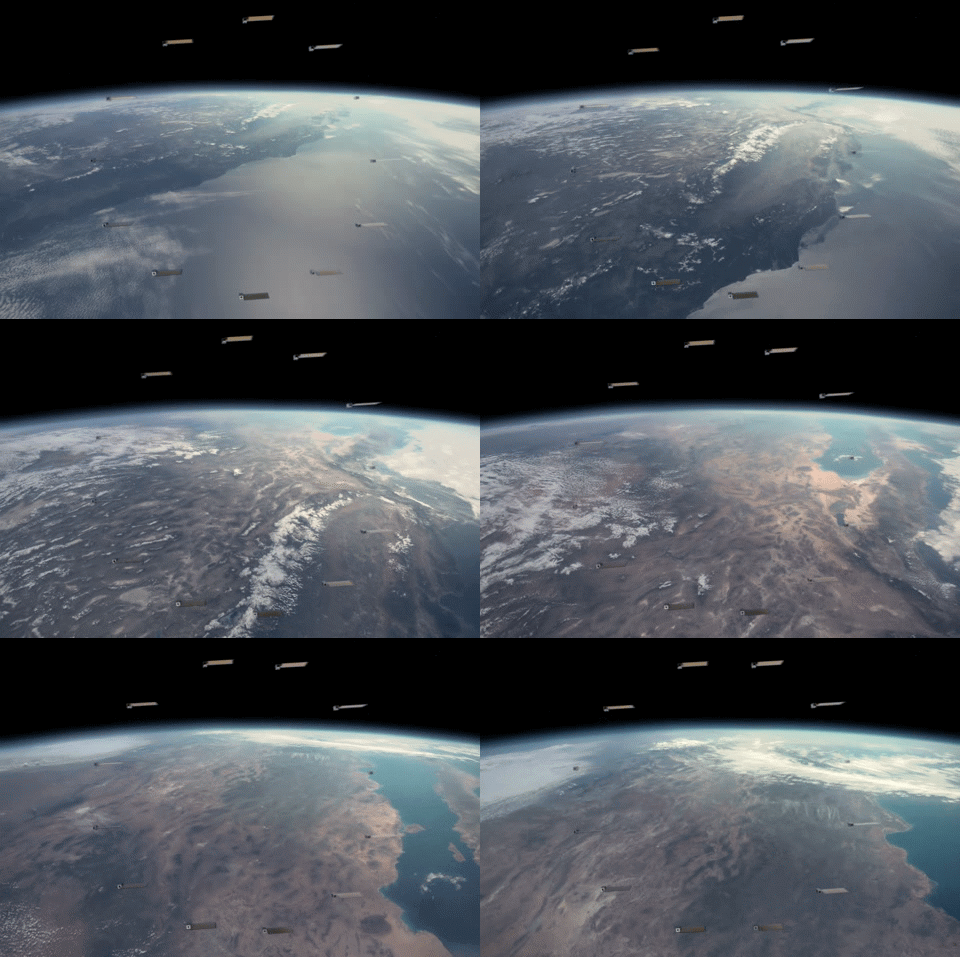
Each transmits radar pulses down to Earth and all of them receive the reflected signals back. The resulting cluster behaves like a 50-kilometer-wide antenna without the exponential costs.
The economics flip in your favor here. Double the satellites in a cluster and you quadruple the daily collection rate for only twice the cost. You get more solar panels generating power, more antennas collecting data, better coverage. Scale actually helps you instead of hurting you.
This idea wasn’t new. The Air Force Research Lab tried it with TechSat-21 in the early 2000s.
TechSat-21, 2003
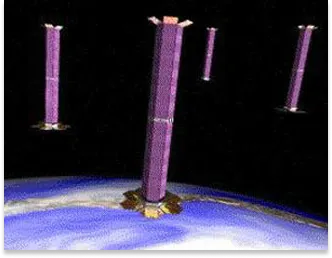
The program collapsed under massive cost overruns. Most people, including investors in the space, concluded the concept was fundamentally flawed.
Instead, Andrew concluded the timing was wrong, that the technology wasn’t ready yet… But he thought it might be soon.
The Timing Question
Several things happened between TechSat-21’s failure and Array’s founding that made the idea viable.
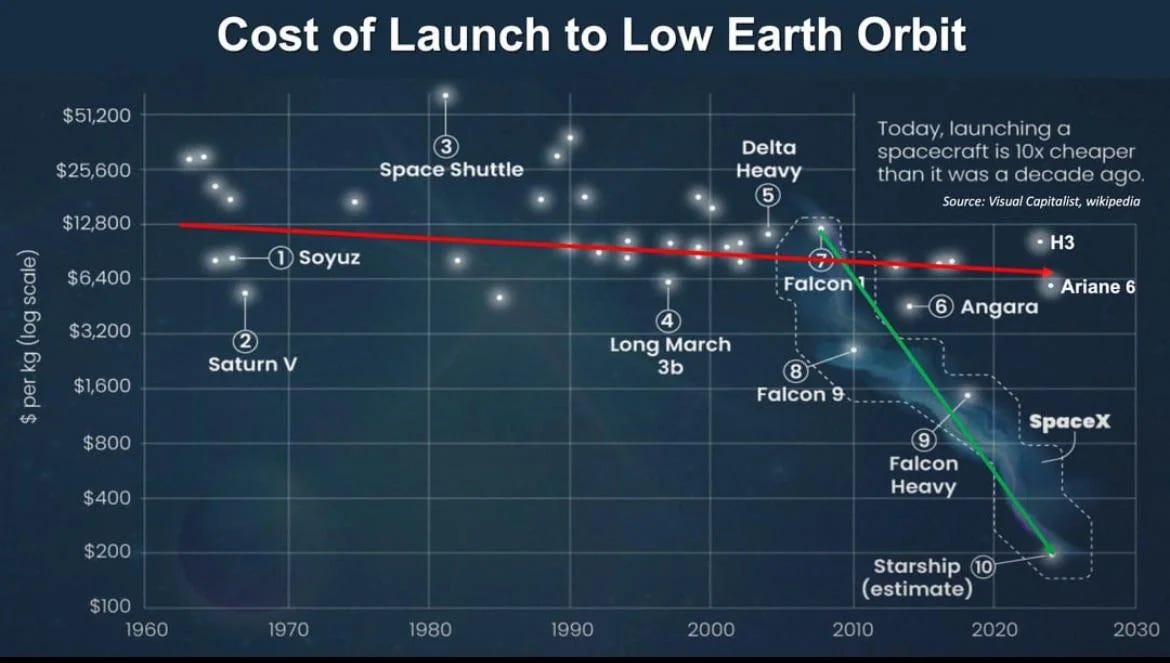
SpaceX dropped launch costs by two orders of magnitude since the 1970s. Array can send their first cluster up for under $1M on a rideshare mission. TechSat-21 didn’t have that option.
Cubesats (very small satellites) used to cost $1-2 million each. Today, they’re around $100k. Moore’s Law compressed what used to require bus-sized spacecraft into something that fits in your hand.
The 5G buildout created another windfall.
Each Array satellite is essentially a cubesat with a 5G base station handling the radar. Billions of dollars poured into RF technology globally drove component costs down while performance went up, meaning Array benefits from telecom infrastructure spending without having to fund it themselves.
Elsewhere, memory is 100x more performant and 100x cheaper than when TechSat-21 attempted this. The prototype used spinning hard drives that weighed 20 pounds and consumed 150 watts. Array’s solution fits on a thumbnail.
These curves converging at once opened a window that didn’t exist before. Andrew saw it and moved.
Traction Before Launch
Array launched their first two test satellites in August 2024.
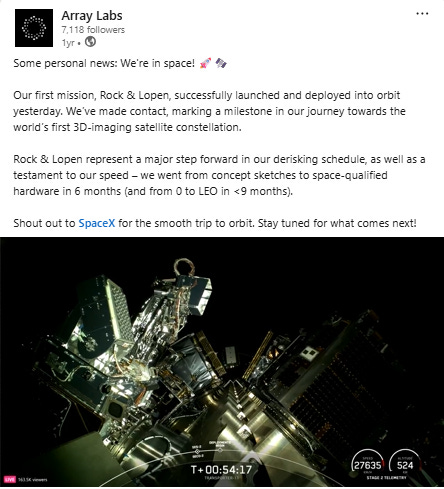
This means, Lobster Capital, along with other funders, invested before the hardware was off the ground. But what convinced us to invest was the customer momentum.
Prior, in July 2024, Array had soft-launched Site3D with Umbra and Raytheon, which formalized into a three-way partnership for advanced 3D Earth imaging by January 2025. Raytheon brought two decades of imagery processing algorithms to the table, and they don’t typically partner with unproven startups. This was a signal that Array could work with major defense contractors before having production satellites in orbit.
Maxar Intelligence followed in October 2024 with an agreement to secure capacity on Array’s 2026 constellation. Maxar operates the largest earth observation business but has been building what it calls a “virtual constellation” by integrating SAR providers into its product line. Array became part of that strategy despite not having production hardware launched yet, which told us Maxar believed in both the timeline and the capability.
Government contracts accelerated faster than we expected. Array won a $1.25M Air Force contract to advance 3D imagery processing, then secured a Navy contract in October 2025 to study space-based Airborne Moving Target Indication, a top S&T priority for the Office of Naval Research.
Congress went further and included Array Labs in the House Appropriations Committee’s FY25 Defense Appropriations bill with a budget earmarked specifically for them. The 5-year Cooperative R&D Agreement with SOCOM that followed gave Array Labs access to security clearances and the ability to propose against classified RFIs, putting them in a very exclusive club.
Commercial customers then materialized alongside government interest. Enbridge, a $76B energy infrastructure company, signed Array’s first Site3D purchase order while evaluation contracts moved forward with Rio Tinto, Trafigura, Chevron, and Palantir. Most earth observation startups struggle for years to prove unit economics, but Array had paying customers before their production satellites launched.
How the Business Model Works
Traditional earth observation has a tasking problem. Customers with deeper pockets pay premium rates to redirect satellites toward specific locations. Everyone else gets older images at lower resolution.
Array’s clusters capture high-res 3D continuously over wide areas without tasking. The business model shifts to subscriptions where anyone can access the data. Marginal cost per additional customer approaches zero.
If one customer covers the cost of goods for a cluster, the second customer means 50% gross margins. The tenth means 90%. This doesn’t look like typical hardware economics. It starts to resemble software margins on a satellite imaging business.
Each new cluster increases global coverage and refresh rates. The subscription becomes more valuable to existing customers as Array scales. The business model compounds in ways traditional satellite operators can’t match.
Why We Backed Array
Array fits a specific pattern we look for. Ideas that seem impossible to most investors often have the largest outcomes if you can actually execute. The impossibility filters out competition.
Array is building radar satellite swarms when conventional wisdom says the physics and economics don’t work. The technical complexity and years needed for orbital validation scared off most capital. Those same factors create the moat.
The regulatory challenges, the hardware risk, the need to wait until 2026 for production clusters to launch... These are features, not bugs, and clear reasons competitors won’t follow until Array has already established distribution through Maxar, proven the technology works, and locked in government contracts.
What’s more, the technology de-risks with each launch. Customer contracts de-risk the business model, with partnerships providing distribution channels most space startups spend years trying to build.
The market spans agriculture, weather forecasting, autonomous vehicles, infrastructure monitoring, and defense applications.
But we didn’t invest in market size projections. We invested in a technical founder who identified an impossible-seeming idea at exactly the moment when enabling technologies made it viable, then executed relentlessly.
Visit lobstercap.com for more