
The Vintage Problem
Why LP's concerns about vintage concentration are legitimate, partially wrong, and ultimately yours to solve


The Vintage diversification question is probably one of the most common conversations I am having with LPs at the moment, and for good reason. Vintage year is the single most important variable in VC fund performance, more so than the manager, brand, strategy, or sector. The difference a few years can make is significant.
However, many LPs are directing their concerns solely at fund managers, which is neither accurate nor fair. Vintage diversification is an LP-layer responsibility, not a fund-layer one.
A single-vintage fund, run with the right deployment discipline, can perform well across any cycle. It would be impossible for a single fund to remove vintage risk completely (this is why we have multi-vintage Fund of Funds).
My job as Lobster Capital’s GP is to run the best possible single-vintage YC vehicle. To do so, Lobster Capital implements precise steps to reduce vintage sensitivity within a single fund and acknowledge where the responsibility sits when it can’t be fully eliminated.
The Vintage Concern
The vintage diversification question has always existed in venture capital, cropping up with a renewed vivacity every few years, normally in line with how the broader market is performing at the time. In a capital-rich environment, the competition intensifies, and entry pricing is elevated. Conversely, a constrained market creates opportunities to deploy at more attractive valuations.
We saw this in the funds deployed in 2006-07 vs 2009-11, where the early vintages underperformed by 400–600 basis points1 of net IRR. Similarly, the 2019 vintage top-quartile funds are tracking 2.5-3.0x TVPI2 and 25%+ net IRR, while the 2021 vintage median sits at 0.95x TVPI and -4% net IRR.
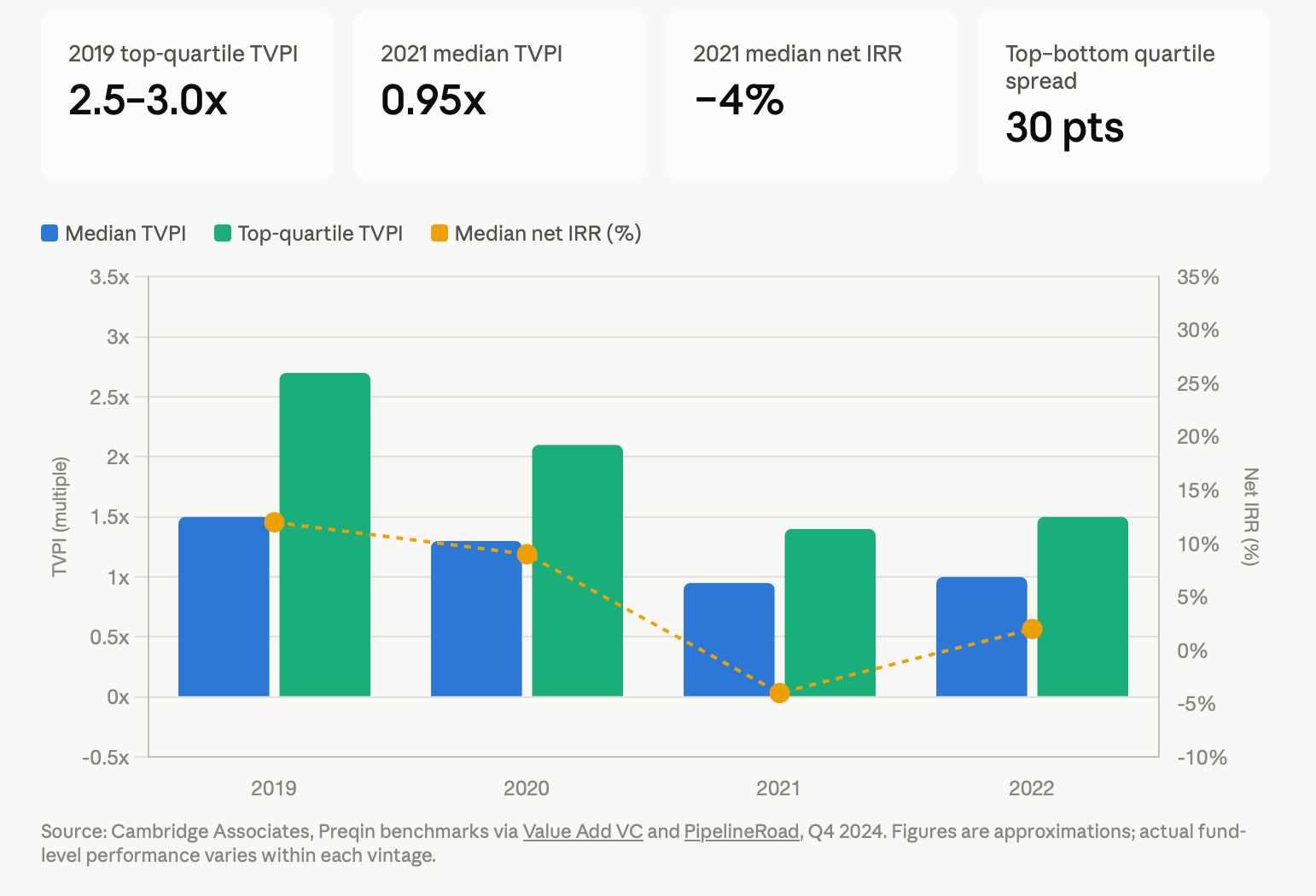
These are from the same asset class, just two years apart. With those numbers, ignoring vintage diversification would be a serious oversight, and so LPs are right to be raising the question. However, the market effect on a vintage is also not fully within a GP’s control. Most of the funds that dropped in 2009-11 were managed by the same GPs with the same teams, and so cannot be pinned on a manager skill problem.
That said, the inability to fully control vintage risk does not mean it should go unaddressed. Lobster Capital’s structure carries three specific features that partially dampen vintage sensitivity, and being inside YC provides a fourth that generalist funds simply don’t have.
Lobster Capital’s Vintage Risk Mitigations
Lobster Capital’s traction filter works as a pricing anchor
The 2021 vintage is the clearest proof that entry price is the dominant variable in vintage outcomes. Funds that entered at 20x+ ARR multiples paid 3-5x more for the same companies as those entering at 7-8x in 2019, and the TVPI gap reflects that directly. By contrast, the 2022 vintage, deploying at 40-60% discounts to 2021 peaks, is already showing 20-30% early outperformance at the same stage. With disciplined entry pricing, funds can build a strong vintage even in a bad market.
Lobster Capital enters at demonstrated ARR averaging $1.7M and with entry valuations of $30M on average. These are proven numbers that anchor the entry price in real revenue, rather than a misleading surface narrative. Traction over narrative is more than a quality filter. We use it as a partial pricing hedge.
YC batch cadence
YC now runs multiple batches per year (4). A single Lobster Capital fund samples the YC outlier pool across multiple market moments within a single deployment period. While not vintage diversification in the traditional sense, this creates a temporal spread within a focused strategy.
The outlier company that drives the fund’s return could emerge from any of those cohorts. With exposure across all the batches within a single fund, Lobster Capital investors have a greater probability of capturing the outlier regardless of which specific market moment it enters, which means that the fund is not entirely dependent on the conditions of any single demo day.
YC acts as a pre-selection layer
YC has backed 20% of all companies valued over $5B since 2012. In 2025, it was the second most active unicorn investor in the world with 36 new unicorn deals. Lobster Capital’s YC focus means that we are operating within a pool that has already been filtered for founder quality at the highest level. Macro cycles still affect outcomes, but the baseline quality of the underlying companies is structurally higher than the broad seed market, which reduces the floor on downside scenarios across any given vintage.
The Limits of GP Control
The above mechanisms help to dampen the vintage effect. All fund managers should be applying a similar strategy at any given moment, because we can never be sure when the market shifts, or how much the shift will be.
2021 was a stress test for all of venture capital: global VC deployment hit $621B with valuations inflated to 20-40x ARR across the board. Even the most disciplined funds entering at the lower end of that range faced markdowns of 30-50% by 2023 as markets corrected. The median 2021 vintage fund has still not returned capital to LPs.
Our lesson from 2021 is that discipline is vital, but that it acts as a partial hedge, not a complete one. The macro cycle affects follow-on availability, exit windows, and public market comparables in ways that no entry filter fully insulates against. Good GPs absorbed that lesson and have since tightened deployment pacing, raised entry bars, and become more conservative on markup timing. These are strategies designed to manage investment around the variable cycle, not control it.
Where the Responsibility Sits
Vintage diversification has a bigger solution, but it sits at the LP layer, not the fund layer. If a fund starts to try to solve vintage risk by hedging its own entry logic and investing earlier, later, or more broadly than the thesis allows, they start drifting from the discipline that generates returns and that the LP likely chose that fund for in the first place.
The more sophisticated LP programs treat venture as a structured investment across cycles, not a point-in-time allocation. For example, commitment to Lobster Capital across Fund I, Fund II, and Fund III has vintage diversification by giving LPs exposure to multiple YC cohorts across multiple market cycles with a consistent entry discipline across each.
Within that framework, Lobster Capital’s role is to run the best possible single-vintage YC vehicle: maximum conviction, maximum discipline, maximum access to the world’s most powerful unicorn-generator. It is the LP’s job to manage macro risk at the portfolio level.
The vintage concern is valid, but often misplaced. A single vintage fund and the GP managing it can implement certain mechanisms to dampen vintage sensitivity, and certainly should. At Lobster Capital, this looks like our traction filter, YC batch cadence exposure, and the pre-selection quality of the underlying pool.
However, the 2021 cycle demonstrated that no entry discipline is a complete hedge against a macro inflection. The cycle also demonstrated that entry price discipline produces materially better outcomes. When funds enter on traction, rather than promise, they consistently show more resilience when the market turns. The rest comes down to portfolio construction, and that part belongs to the LP.
Visit lobstercap.com for more