
Build It, Use It, Forget It
Why Personal Software Is Eating Commercial Software

The Shopify CEO just built a custom medical imaging viewer by asking Claude to do it.
Tobi Lütke prompted Claude to scan his USB stick, parse DICOM medical imaging files, convert them with ImageMagick, and create an interactive HTML explorer with navigation and spine labels.


Will he use it again? Probably not.
Does that matter? Probably not.
This is what I’m calling “reflexive AI use” - building exactly what you need, when you need it, without the overhead of traditional software.
This behaviour is creating a new category… disposable software.
The Disposable Everything
Recently, there have been more and more discussions about ‘personal software’ : startups like Wabi are targeting the rise of the mini app, and other established players like Replit are trying to take away any friction in software development like APIs and IDEs.
The premise of all of these is building exactly what you need, when you need it.
The value here is that these problems and use cases are so specific and fleeting that no commercial product would ever solve them.
Partly, this is because a lot of these use cases might only get used once or twice before being forgotten entirely.
This is disposable software. Obviously, we are familiar with disposable products like cutlery, but increasingly we are used to ephemeral messaging in Snapchat, or stories on instagram where content auto-deletes after viewing.
A16z recently wrote about how YouTube is a herald for what’s coming with coding - YouTube in 2005 didn’t fill an obvious content gap, yet two decades later it’s a $550B business more culturally relevant than traditional TV.

But in their piece they argue that the difference between the two is that content decays whereas software value compounds.
While this is true at its core, I see a future where just like most content, most software decays too.
People will create software for random entertainment, for memes, to learn something specific, then move on. It’s disposable by design, meant for the moment, rather than permanence or scale.
But Scale Matters Sometimes…
This point of scale is an important one, and is often lauded by the anti-vibe coding brigade.
I saw this great tweet breaking down why DocuSign needs 7,000 employees. At face value it seems absurd, especially when you can literally clone Docusign in about an hour with Claude.
However, try and process 35 billion signatures a year across 180 countries. That’s 1,000 signatures per second, every second, 24/7. They need to follow local contract laws in 100+ jurisdictions, run hybrid on-prem/cloud systems in every region, maintain redundant backups because records can’t go offline, and staff 24/7 customer support because real estate deals close in hours and court requests are time-sensitive. They serve over a million paying customers including 3,000 government agencies and most of the Fortune 1000.
This is clearly permanent software that needs to exist and get better forever, where the value compounds with every signature processed.
Traditional software operates on high cost, high value.
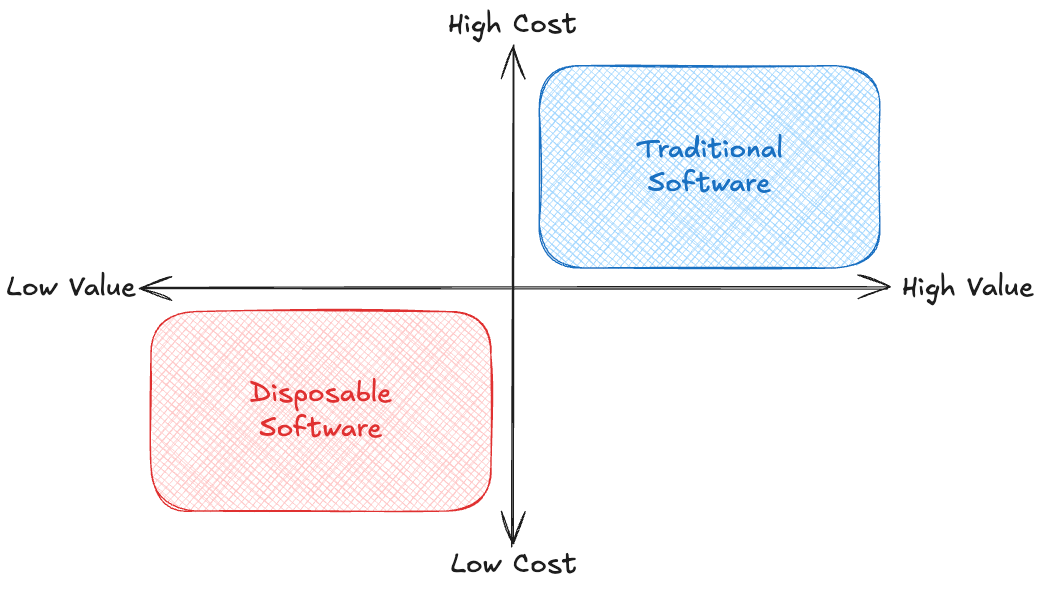
But most people do not operate at that critical edge.
Most people just need something for that task, that day. Maybe it recurs, maybe it doesn’t. Fast and loose, output-oriented, where the quality bar is lower when the stakes are lower.
The Mini-App Moment
This is also where mini-apps come in. Full apps are too hard to make… authentication, integrations, databases, deployment infrastructure. But almost anyone can describe one idea, one flow, one screen.
At the moment, it can take 10+ minutes to go through onboarding in some apps just to get you to subscribe. At that point it’s genuinely faster to build your own mini-app than figure out theirs.
What this unlocks is something like UGC for software, and potentially the first real consumer super-app in the US, which the aforementioned Wabi is running after.

However… I honestly think the prosumer angle is more immediate and interesting.
The Prosumer Opportunity
Prosumers - power users, creators, indie hackers, analysts - already glue together spreadsheets, scripts, Notion, Airtable. Now they’re using AI to generate bespoke viewers, dashboards, scrapers, workflow helpers for themselves or small audiences.
Here you can still accept rough edges and treat software as ephemeral infrastructure the same way they’ve long treated Google Sheets or Zapier zaps - prosumers have long been building disposable tools on these platforms.
These use cases will also accelerate because of local inference. In three years you’ll run a pruned-down Gemini 5 or Grok 4 on your phone or laptop, for free and on-device. Apple’s strategy is obvious - privacy-safe, runs locally. This means you can bake in security to your workflows without needing keys and authentication, which are some of the most friction laden parts of current vibe coding.
I think what this also enables is that work styles get more flexible. Organizations will still have centralized software - Oracle, Salesforce, systems designed for scale, compliance, “truth.”
But what if you prefer working one way and I prefer another? Disposable software lets us hit the same outcomes without forcing everyone into the same rigid workflow.
Tom Blomfield, had a clear example of this phenomenon just yesterday:

Yes, defensible businesses will still solve problems requiring deep domain expertise, system integration at scale, network effects, customer service infrastructure, regulatory compliance, reliability guarantees. DocuSign isn’t going anywhere. Neither is Salesforce or Figma.
But the long tail… the niche use cases, the “I just need this once” problems -those are increasingly getting handled by software built in minutes and forgotten by tomorrow.
I believe there is a startup opportunity formalizing this via sanctioned AI sandboxes with governance for enterprises.
But either way, we’re definitely about to see an explosion of creativity that looks nothing like traditional software development. And most of it will be disposable.
Visit lobstercap.com for more.
I think this is a temporary phase - a million people around the world have suddenly discovered the power of Claude Code and are using it. Personal software should not conflict with commercial software in the long run. All software rots over time, and even though LLMs can recreate them on demand there will be people who want some things to just work. For decades. The opportunity I see is for small-scale commercial software to emerge as a category. The other opportunity I see is for the next corporate giants. Because it is finally possible to build a company in your basement again, after 40 years.